TRANZIT#6: “MA-THE ART OF SILENCE” (RESEARCH LAB)
8.8.2025.
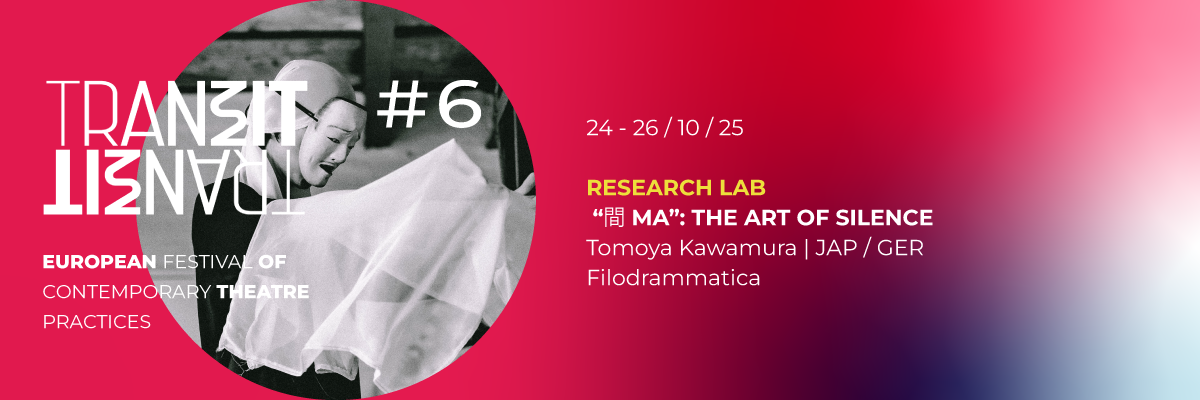
Research lab “間 MA”: The Art of Silence
Author and leader: Tomoya Kawamura
24th October 2025 – 26th October 2025
>>Friday 6.00 p.m. – 9.00 p.m.
>> Saturday 10.00 a.m. – 3.00 p.m.
>>Sunday 11.00 a.m. – 04.00 p.m.
Public presentation of the research lab: 26th October 2025. at 4.00 p.m. (entrance free)
Filodrammatica, Korzo 28, 1st floor
⚟ TRADITIONAL JAPANESE THEATRE, NOH, KABUKI, concept of “MA” (Silence)
Language: English
Apply to participate via online form.
Participation fee: 50,00 – 65,00 euros
In this lab, we will explore methods that apply the techniques and styles of traditional Japanese performing arts, such as Noh and Kabuki, to Western dance and theater techniques, using the theme of “Silence.”
Participants will experience the breathing techniques, focus and target of awareness, body usage, and stage presence techniques used by performers of traditional Japanese arts. They will then train in integrating these elements into their own dance and theater techniques. In traditional Japanese performing arts, “Silence,” or „Between“ known in Japanese as ma (間), plays a crucial role. Silence brings a poetic quality to the stage and transforms it into a space distinct from everyday life. It is also deeply connected to Buddhism and can sometimes induce a state similar to Zen meditation.
This lab will introduce how Silence is perceived and utilized in traditional Japanese performing arts while exploring ways to integrate it with Western physical theater and dance techniques. Through this fusion, participants will train in a completely new approach that they can apply to their practice.
This lab investigates a new performance methodology that fuses the physical-spiritual techniques found in traditional Japanese arts—Noh, Kabuki, Nihon-buyō—with selected methods from Western performing arts.
Participants will explore where to place their target of awareness, how the performer relates to space, and what the uniquely Japanese concept of ma (間 = “interval / silence / in-between”) means in practice. We also reference Zeami’s 600-year-old Noh theory to examine its compatibility with contemporary stage work.
LAB Structure
1. Breathing Work & Warm-up
- Noticing and analysing one’s ordinary breathing
- Focusing on the tanden (the body’s centre in East-Asian thought)
- Differentiating everyday breath from on-stage breath
- Experiencing how traditional Japanese theatre uses breath to create an “other” space
- Practising complete exhalation and inhalation driven from the tanden
- From this point onward, all tasks are performed with tanden-centred breathing, allowing the body to move as a reaction to breath
2. Layering Awareness & Expanding Spatial Sensitivity
Building on the breathing practice, performers progressively open their awareness (awareness circles):
Three Awareness Circles
- 1st Circle – Inner Focus
Concentration on the body’s interior (muscles, bones, organs, blood flow) and on inner thoughts, memories, imaginings—an actor’s inner monologue. - 2nd Circle – Immediate Environment
Engaging only with what physically exists here and now: the person opposite you, objects in the room, audible sounds, temperature, textures. (Inspired by Meisner repetition.) - 3rd Circle – Imagined / Cosmic Focus
Connecting to distant or imagined stimuli—the roar of waves 1,000 km away, stratospheric light, a newborn’s skin on the planet’s far side—extending far beyond the room.
3. Physical Warm-up & Introduction to “Forms”
- Moving the body through breath-led warm-ups
- Repeating set movement “forms” while maintaining breath awareness
- Demonstration and practice of basic forms (e.g., walking patterns, suri-ashi sliding, sashikomi, hiraki from Noh footwork)
4. Exploring Space and „Ma“
- Training perceptual approaches to space
- Sharing the Japanese concept of ma—the pregnant pause between sounds, movements, people, or objects
- Group investigations: “What is ma?” and practical exercises embodying it
5. Creating Personal Forms & Applying „Ma“
- Participants devise 5–10 original forms of their own
- Emphasis on the ma that bridges transitions from one form to the next
6. Mask Work (optional)
- Movement sequences performed with Noh masks, Western masks, and original masks
- Integrating masks with each participant’s forms and sequences
7. Showing / public presentation
- Participants are asked to bring a poem or song in advance
- Each performer combines their movement sequence with the chosen text or song (5–10 min each)
- Mask use is welcomed
The lab is aimed at the professional and upcoming artists and students, as well as other professionals interested in the theme of labs.
Due to the limited number of participants (12-16), registration is mandatory. Applications are accepted until October 22, 2025, or earlier if the group is filled. After registration, you will receive a confirmation email and payment instructions. The price of the research lab is 65.00 euros and is paid in advance to the bank account of the art organization KRILA. For early registrations and payments by September 17, 2025, and for students, we have ensured a discount, and in that case, the fee is 50.00 euros.
Author and the lab facilitator
Tomoya Kawamura is a Berlin-based actor, physical theater performer, dramaturg, and director from Tokyo Japan. He has nearly 15 years of professional experience in traditional Japanese mask theatre and also experience in Western theatre as an actor since moved to Berlin in 2019.
Based on this, the most important productions in recent years have been “Ich hab die Nacht geträumet” at the Berliner Ensemble, and “Madama Butterfly” at the Festival D´Aix-en-Provence both directed by Andrea Breth, where he was involved in the production as a Movement Director and Choreographer.
The focus of his work is on contemporary and socially relevant issues such as queer spaces, gender roles, and integration, as well as war trauma, and mixing them into Japanese / Eastern Traditional Theatre, such as Noh Theatre and Kabuki Theater. He studied Kabuki and Noh Japanese traditional Theater Performing under the master Kabuki actor Omezo Ichikawa the 6th (2009.- 2018.), as well as Noh Theater Education with Kanze Group (2013. – 2018.).
Production: Creative Laboratory of Contemporary Theatre KRILA
Artistic Director and Curator: Ivana Peranić
Visual identity: Ana Somek
Design of promotional materials: Katarina Ratkaj
Financial Support: The City of Rijeka, Ministarstry of Culture and Media of Republic of Croatia, Primorsko-goranska County, Kultura nova Foundation
Logistic Support: HKD na Sušaku, Savez udruga Molekula
Partner: Choreoscope – Barcelona Dance Film Festival
Media Support: H-Alter, Kulturpunkt.hr, Rijeka Danas, Novi list, teklić.hr svakidan, Rijeka Tourist Board
Follow us:
FB: krila.laboratorij i Festival TranziT
Insta: krila.ri